
New to
climate information?
This is a learning zone where you can learn more about climate information. It provies basic knowledge about climate models, emission scenarios and much more.
How to calculate the impacts of climate change?
The climate indicators provided at climateinformation.org are the end result of a long chain of model simulations and statistical calculations. Here we first provide a general overview of how to estimate local changes in climate indicators with the necessary steps for an impact assessment. After the overview we provide more in-depth information about models and methods along the chain.
From greenhouse gas emissions to future climate trends
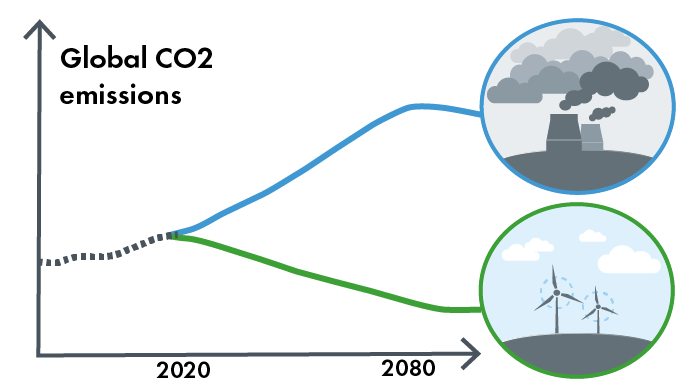
A starting point is the emissions scenarios. What would you like to look at? Business-as-usual or a moderate path? Scenarios for the evolution of greenhouse gas emissions are provided by Representative Concentration Pathways (RCPs) or Shared Socioeconomic Pathways (SSPs).
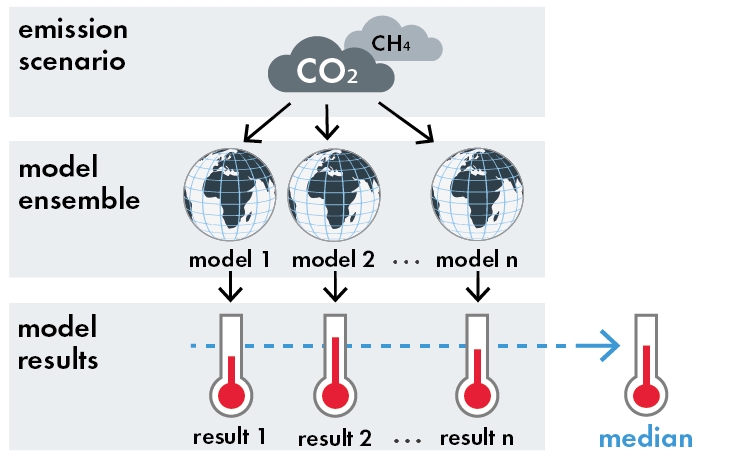
Global Climate Models (GCMs) are then applied to calculate projections of how the emissions affect climate. The various GCMs differ in their sensitivity to the greenhouse gas forcing, and also in how they simulate different processes in the Earth’s climate; each having their own strengths and weaknesses. An ensemble of models has proven more reliable, as the uncertainties stemming from the different models to some degree cancel each other. Ensemble statistics, e.g. the median result from of a number of models, are therefore generally considered more reliable than using a single model projection.
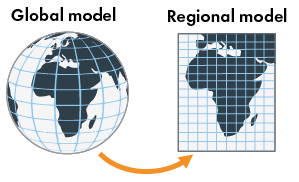
GCMs have a typical horizontal resolution of several hundred kilometers, and since e.g. most hydrological processes occur at much smaller scales, a further downscaling of the GCM information is useful . This is performed by Regional Climate Models (RCMs), which nest into the GCM and provide finer scale information of 50 km or less. CMIP(Coupled Model Intercomparison Project) and CORDEX (Coordinated Regional climate Downscaling EXperiment) are two global collaboration programs under WCRP (the World Climate Research Program) of WMO (World Meteorological Organization) that coordinate GCM and RCM ensembles respectively.
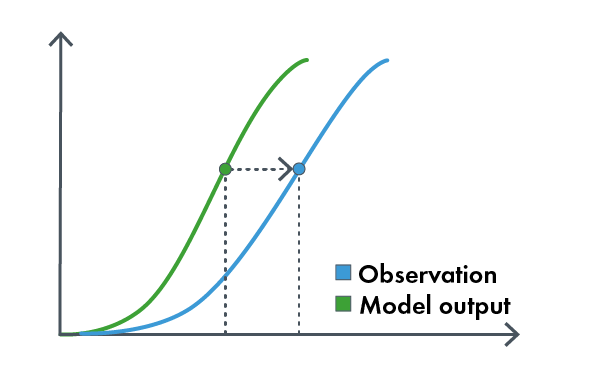
Hydrological and other impact modelling applications are sensitive to climate model bias. Bias is a systematic deviation from observed statistics, e.g. consistently too wet or too warm climate in a certain region of the world. It is common practice to apply bias adjustment, a statistical method that removes various errors from the climate model output so that they become more similar to observations (local gridded or station data) or reanalysis.
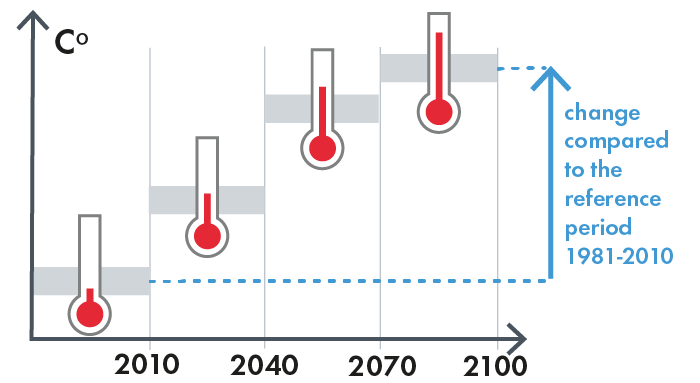
Climate and water indicators are produced, at the end of the computation chain, to show how the climate changes between different time periods and for a given emission scenario. Since climate is an average of the weather over a long period of time, indicators are often produced as an average over thirty years.
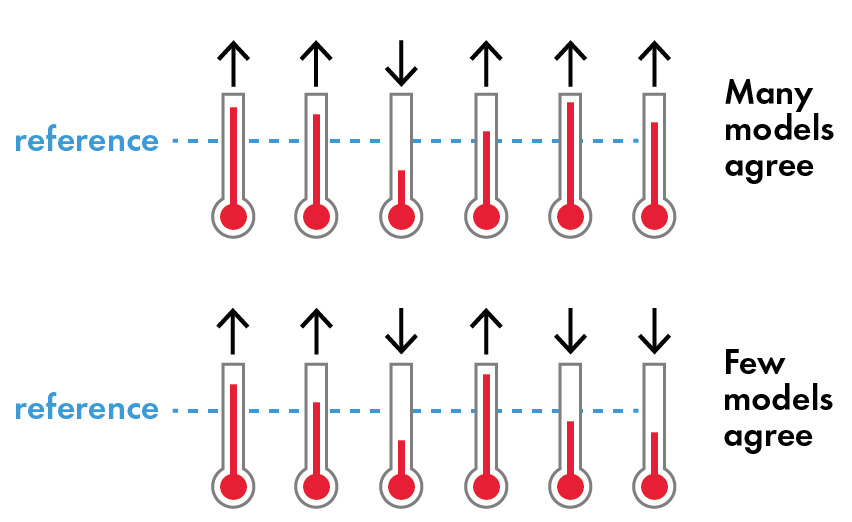
Each model step in the production chain includes uncertainties, with the main uncertainty within each emission scenario arising from the climate models. Therefore, an ensemble of projections (multiple RCMs and/or GCMs) is used to account for the spread of possible climate impacts in the future. The uncertainties inform about the reliability of the climate projection, e.g. if all models agree on the sign of the change, and how well they agree on the magnitude of the change. The exact future still remains unknown but the indicators show tendencies and future risks generated by climate change.
Models and Methods
What is a climate model?
Climate models are our main tools for calculating the future and historic climate. Scientists often use climate models to study how the climate may change when the composition of the atmosphere changes with, for example, changed levels of greenhouse gases and aerosols.
The climate models are three-dimensional mathematical descriptions of the climate system: the atmosphere, land surface, oceans, lakes and ice. In a climate model, the atmosphere is divided into so-called grids along the earth’s surface that extend up into the air, as visualized in the figure.
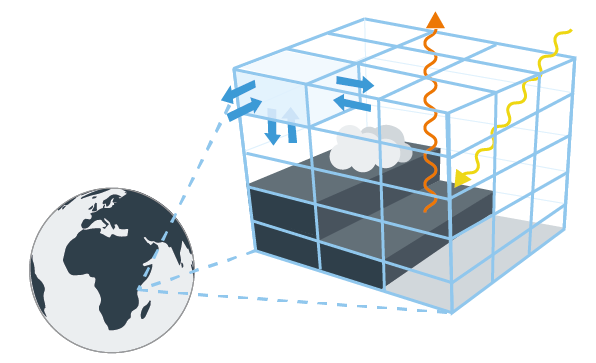
The movements of the atmosphere and the preservation of energy, water and mass follow well-known physical laws that can be described by mathematical formulas. For each grid various processes are calculated, such as heat, wind, generation of clouds and precipitation. A global climate model (GCM) describes many processes both in the atmosphere, ocean, land and cryosphere such as glaciers and ice-caps. A regional model relies on input from the global model and can focus on local processes.
It requires a lot of computer power to run a climate model, and even though the computing capacity is constantly increasing, calculations in the global climate models are still made with a rather sparse grid of several hundred kilometers. This means that the level of detail on a local or regional scale is low in the global model. However, if you want to study a smaller part of the Earth in more detail, you can use so called regional climate models (RCM). In a regional model, the grid is positioned over a smaller area, which means that you can get a denser grid (and more detail, e.g. 50 kilometers) with lower computing power. What happens outside the calculation area in a regional climate model is governed by the results of a global climate model. In this way changes that take place outside the regional model area are considered. This way of using the results from a global model in a regional model is called regional downscaling.
What is the difference between climate and weather?
What is a model ensemble?
What is CMIP?
What is CORDEX?
Figure? Logo?
What is an emission scenarios?
What is RCP?
What is SSP?
The SSP-scenarios (Shared Socio-economic Pathways) are five scenarios that describes different socio-economic developments used in climate models. The SSPs has been introduced because the climate is changing due to the emission of carbon dioxide, other greenhouse gases and the change of land use . These factors such as emissions of carbon dioxide, other greenhouse gases and the change of land use are crucial to describe the evolution of the future anthropogenic climate forcings and, and therefore the climate scenarios need to take these factors into account. The SSPs differ in terms of, among other things, population development, equality, energy use and global carbon dioxide emissions. In all SSPs, the global economy is growing. Read more about the characteristics of the SSPs in the article “What is SSPs? and What is the difference between SSPs and RCPs? ”.
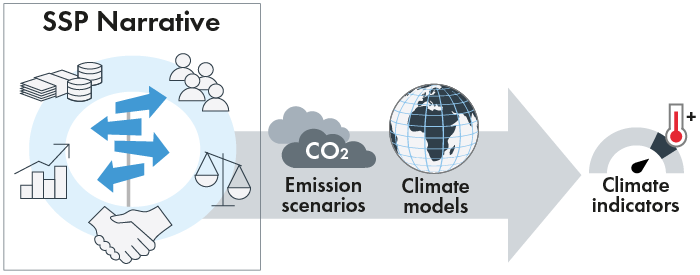
None of the SSPs are more likely than the other but the world can develop in several different ways depending on decisions in a number of different areas, where different paths are possible. All SSPs pose different major challenges for emission reductions and adaptation. However, no actual climate policy is included in these scenarios. Although climate policies can be explored in studies based on the conditions provided by the scenarios, for example to achieve a certain emission reduction.
What is a climate scenario?
What is bias adjustment?
The complex climate system, with many interdependent processes that are not always fully known or described in the climate model, inevitably leads to the climate model producing systematic deviations from observed values. These systematic deviations are called model bias. The bias can be of different magnitude for different variables and for different regions of the world. Most often, these deviations do not pose a problem for calculating climate indicators where the focus is on differences between a historical and a future scenario. However, some indicators are based on absolute limits, such as the number of days with frost, tropical nights, or precipitation above a certain level. A bias in the climate model can affect these indicators so that their interpretation is misleading. To remedy such issues, the variables are bias adjusted using a scientific developed method based on defining a mapping of the range of model values to an observed range of values. The method used here is called quantile mapping, and two different versions of this technique are used depending on the production time of the indicators. The CMIP5 (those using RCP emission scenarios) models are bias adjusted using the Distribution Based Scaling (Yang et al., 2010), and the CMIP6 uses the newly developed method MIdAS (Berg et al., 2022).
What is a climate indicator?
A climate indicator presents a parameter that describes the climate for a given longer time period. It can for example be average temperature, global radiation and days with snow cover, or using hydrological impact models, for example the annual river discharge. Many of the climate indicators are presented as deviations from a reference period to describe how climate is changing. Here, the reference periods 1981-2010 is used for CMIP5 based indicators, and 1991-2020 for CMIP6 based indicators.